Thursday, June 1, 2017

Drawing What We See- Still-Life in Kindergarten

Doll leaning on pitcher

All through the school year, Kindergarten artists have been practicing the skill of seeing. Seeing shapes (that apple is pretty much a circle), seeing lines (stairs are like a zigzag line), and seeing letters (the branches of the tree are like the letter Y over and over again).

Red bottle and vases of flowers 

Each time we draw something in art class, we consider those observations as questions: If I want to draw an alligator, what are its shapes? What are the lines I need?  Are there any letters I see that will make it easier to draw?
Two toy monster trucks, apples, and a pear
At this point in the year, they are really good at this. So as a challenge that I have never done before with Kindergarteners, I set up four still-life displays throughout the room, full of fruits, toys, dolls, blocks,  flowers, shells, and vases. Each artist practiced using their hands as a view finder, and zooming in on a favorite part. The job was to use their prior knowledge about shapes, lines, and letters to draw what they saw as realistically as they could- in Sharpie.
Toy plane on a book, animal bones, and a doll 
That last part, the Sharpie, might seem unfair- what if we make a mistake? they wondered. How will we fix it?
Toy truck carrying a dinosaur and a stack of blocks
Mistake-making was the very idea. Make errors, work with them, draw over and around and make it into something you love. Find flexible solutions. Show all the work it took you to make this picture. Sharpies do that beautifully. 
Blocks, fruits, vase of flowers, and truck carrying dinosaur, on checkered cloth
Artists used crayons to add color to the objects, and liquid watercolors to make a background. 

Truck, blocks, and vase of flowers on a table
The marvelous part was their excitement that they really could, in fact, draw from life, Kindergarten artists are game for everything I throw at them, and this was no different- their reactions to all of this were beautiful and priceless, including many squeals of delight at how much they love to draw. 

Vase of flowers on star-print cloth
I have been told before that Kindergarten artists are too young to do this kind of observational drawing, that it would only frustrate them, but their work evidences otherwise- they are such excellent and truly curious observers, that they notice and include the tiniest details. They have a strong stamina for art now, and worked on these for two classes. 

Ferns and flowers in a vase on plaid cloth
Especially when they have the freedom to select the area and content of what they want to observe, the rest falls easily into place for them. Look at the details of that fern!

Red bottle and two books on plaid cloth
This is why I save their artwork all year, so that families can see this growth in their finished Kindergarten art books. The skill in their work is amazing!

Friday, May 5, 2017

Abstract Paintings in Kindergarten


Kindergarten artists have been exploring abstract painting and printmaking in art class. 
They are so fantastic.


By which I mean both the paintings and the students. Feeling really lucky about this bunch of artists, they are so excited for everything they are learning!


This lesson began with printmaking- we used sponges, bottle caps, bubble wrap, special shape brushes, and cardboard to print paint onto the background papers. For the bubble wrap, artists painted it with a brush, bubble side up, and pressed it lightly onto the paper. In between students, I gave it a quick rinse and pat on a towel so that the next artist could choose new colors. You can see the bubble effect, the pattern of small purple circles, in the painting above, and in the painting below the bubble wrap was painted with purple and pink stripes.


We definitely needed smocks! The rest of the items, bottle caps and such, could just be dipped directly into the paint, which I put out on plates at tables for the students to use.


 In the work above you can see all of the bottle cap circles at the bottom of the painting.


We talked about layering, about how the first day of printmaking was going to be our under-painting. The next art class, we used only paint brushes. Students looked carefully at their dried prints to find areas that they loved best. Around those, they used their brush to paint circles in different sizes.  These were their Circles of Love, indicating the parts of their work they liked best.


Inside the circles, they let the under-painted first layer show through, and  did not add any paint. Outside of the circles, they could "paint away" any part they didn't love, adding patterns, and experimenting with color mixing.


In this lesson, I specifically steered clear of showing them the abstract paintings of professional artists. For this age, getting their hands into such fun materials and tools is so much joy-of-discovery, and I wanted them to experience that feeling first. 


Abstract art doesn't come with the heavy rules of realism which can burden and frustrate artists, and it doesn't distract the viewer with intentional "real" images. Instead, students are free to explore shape, color, line, and texture, and doesn't have right or wrong answers.


If you are looking at these at home with your child, don't assume that they are not "about" anything! Feel free to ask your young artist to tell you about their work, and feel free to tell them about what it reminds you of, what you see in it, and how it makes you feel!


Tuesday, April 25, 2017

Lost in Space

3,2,1, Blast Off!


Explorers in first grade are making art this is pretty (ahem) out-of-this-world! 


In connection with the science unit they are doing in their homeroom on cycles and phases of the moon, these students are using visual art to express additional knowledge that they have learned about space. 


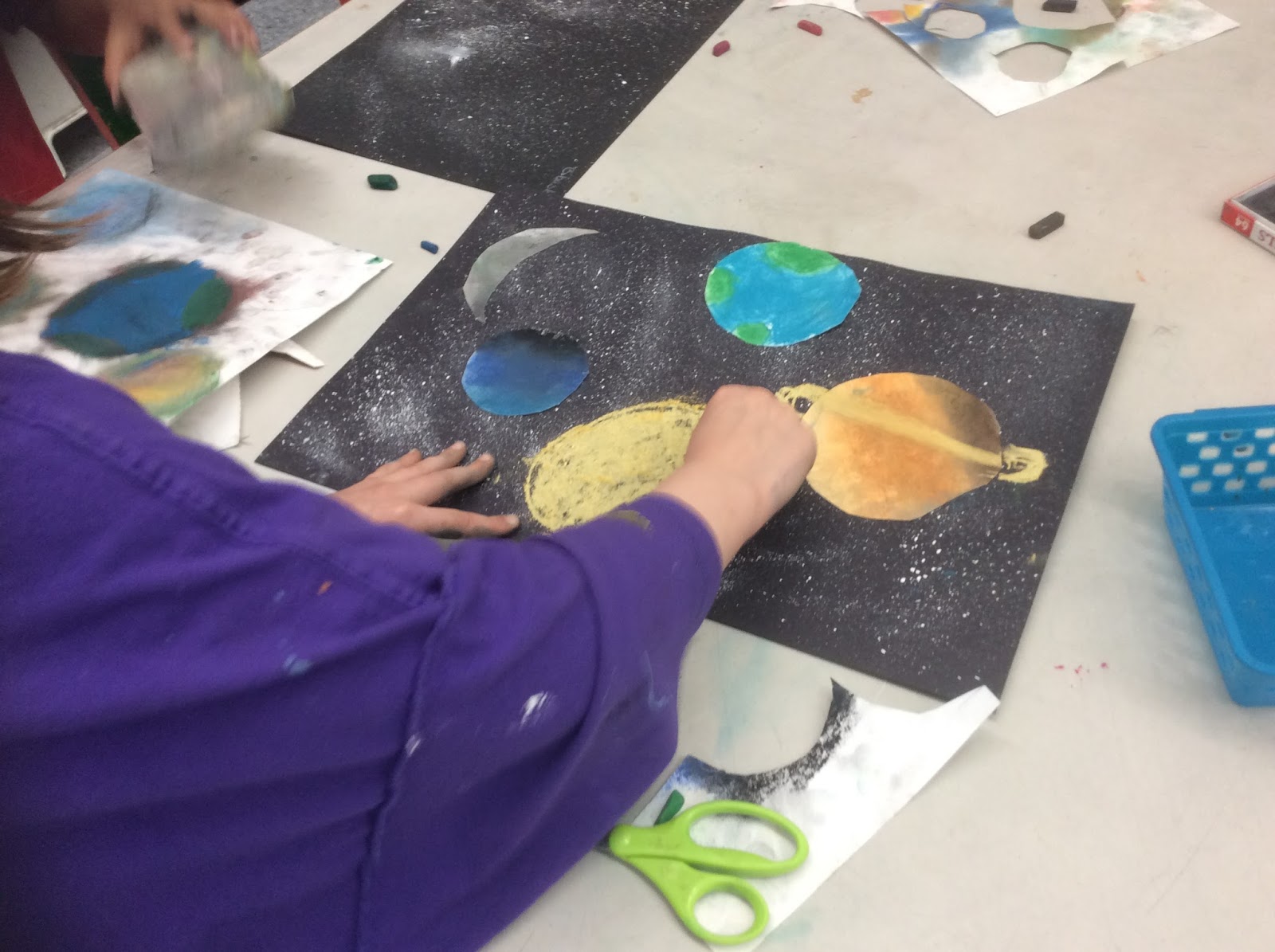
Visual art provides learners a chance to show understanding in a different format than, say, a science notebook or moon-observation journal. In this lesson, students began by using white paint and a toothbrush to create a galaxy of tiny stars on dark paper. That same day, students began to create planets, using white paper and chalk pastels. Many students drew from what they remembered about the light units in art and science classes and attempted to make their planets look very spherical with different shades of pastel.


The great thing about beginning the planets on separate paper is that if there is a perceived mistake, smudging outside of their circle, or a planet that the artist doesn't like, it can simply not be cut out and added to the background. Planets which the students were pleased with were cut out and glued on once the backgrounds were dry.

Because this lesson is intended to give students another place to express their learning about space, we talked about what phenomena and objects are objectively observable and true about space. While you might wonder if they were disappointed not to put a face on their sun or an alien on the moon, they were not, as they were excited to be asked to "show what you know" about our galaxy.


Artists included additional objects of their choosing in their images, including things such as the moon (in different phases), constellations, satellites, meteors, rockets, the sun, and more.


Some artists went above and beyond integrating what they remembered from the light unit, making sure that the bright sides of their objects, such as planets, faced the sun, to create a more realistic model of how light would act on those objects.


Many students used strategic cropping of their objects to suggest that the vastness of space is endless, and let their shapes run off the edge, like the moon in the work below.


This lesson offers so many opportunities to practice skills first graders are building, especially cutting curves, making complex shapes (like stars), tracing an object (circular things like yogurt containers were traced for planets), and blending/mixing colors.


"The sky is the ultimate art gallery just above us."
Ralph Waldo Emerson

Sunday, April 23, 2017

Go, Science! My New Lesson in the Latest Scholastic Teacher

In their newest issue, Scholastic Teacher Magazine has just published my light up origami lesson, which I blogged about here last year. My issues arrived on the day of the March for Science!

Yippee!  Enough copies to share in my classroom!
The part of this news which really excites me is the idea that more children in other places may get the same opportunity to merge art and technology in school.


This is the second art+tech lesson of mine they have published this year.  Here is the blog link to the first lesson, Light Up Magic Wands. Go science!


Wednesday, April 19, 2017

Pinch Pot Creatures

   Children love clay. 
SO much.


For many years, EES students have spent a week per year heading to BCA's clay studio, but, alas, BCA is in the middle of a move to a new home on Pine Street, and we will not go this year. This is approximately what the children looked like when I told them this news.

Pixar shows it well.
In flew the PTO to rescue our students, by purchasing a couple hundred pounds of air-dry clay!  Thank you families, you saved the day! While I don't have a kiln, we were able to build lots of non-utilitarian sculptures and vessels, which while they are not safe for food, look totally awesome.


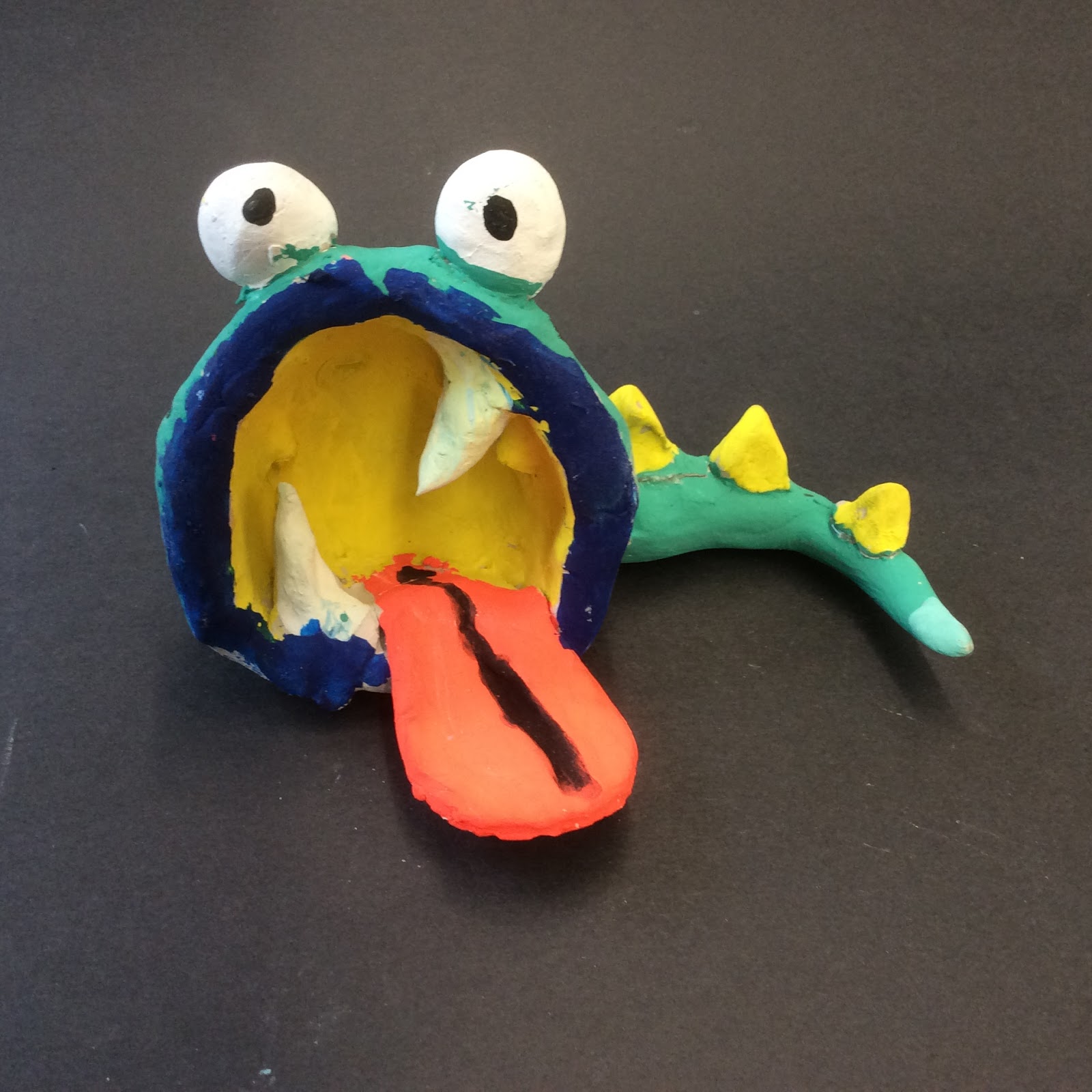
BCA has primarily had students throw clay on the wheel, so for many of these young artists, hand-building with clay is all new. The techniques I wanted 3rd and 4th graders to have include slipping and scoring to attach parts, and the know-how to make a basic vessel like a pinch pot.


The class looked at many examples of how artists use pinch pots as a basic form for a bigger sculpture, and were inspired to make a variety of aliens, creatures, animals, and monsters.


The artist of the work above wanted hers to be useful, so she poked several holes in the back to put lollipop sticks into, to display candy.

The back, with five holes for lollipops.
Students discovered that like with all clay, fired or air-dry, pieces which are not well attached are prone to falling off. Fortunately, students could hot-glue on anything which detached.


Lots of artists' work evolved into multi-media sculptures, adding details like feathers, pompoms, or wire.
Vampire bunny
Long wire eyelashes
Some artists made "minis" to either attach to their main pinch pot, or even to sit inside of it.

Mama and baby frog with wire "fly"
Stacked pinch pot alien
The "Baby" creature sits inside of, and can be removed from, the larger one.
One artist even decided to make hers conjoined, creating distinct faces and designs for each part.


We used SchoolSmart grey clay, and while its working properties are very similar to that of real clay, it was more crumbly when dry than expected and far more fragile than the real deal. If you have had success with a different brand, please share about it!

For students, it was just so exciting to finally have their hands into clay again, that they didn't mind the texture one bit. They look forward to using it again!


Saturday, April 15, 2017

Clay Dessert Containers

If you haven't eaten in a while, go get a little snack and come back to this later. You will not want to read this post while hungry.

I warned you.
Most humans love food. So it is pretty easy to get a group of children worked into a frenzy over the idea that they will be creating homages to deliciousness.


The real agenda of the project was getting students to consider how to create hollow-form vessels of three dimensional objects. Students used a planning sheet to draw both what their work would look like from the outside, and also what shapes would be needed to create the object out of clay, as a container.
A Chesster ice cream cookie sandwich
Consider this cookie sandwich, above. To create this object as a hollow-form container, the student drew a plan that showed he would need two circles of the same diameter, and a long, rectangular strip of a length slightly shorter than the circle circumference. Clay plan in hand, he created this accurate work out of clay slabs which he rolled and stretched on his own.


The plans were created by each artist prior to beginning in clay. The student who made the cake above drew a plan to include two same-size triangles, two rectangles that shared their long side with the triangles, and a square for the back panel.


The goal of this approach was to overcome the guess-and-check approach that can lead to frustration and endless restarting. Using relative measurement (the length of the rectangle needed for this cupcake wrapper is the same as the circumference of the circle for the bottom) lets students make a plan without to much pressure- no rulers needed.

Hot cocoa, whipped cream, and mini-marshmallows!
Math and geometry-minded students excelled at this approach, and plenty of creative space was left for students to create an idea truly their own. I have often seem this project done with a lens I think is too narrow (everyone is expected to make a cake, or everyone makes a pancake stack) to allow for the kind of individual expression and differentiation I look for in a lesson.


The simplicity of the approach- create a three-dimensional, hollow container using your knowledge about geometric forms and faces- lets students explore a wide range of responses at their own level.


Our inspiration artist was Wayne Thiebaud, who is a painter. He is an American contemporary artist, currently 96 years old, and is well-known for his artwork depicting enticing, colorful objects, particularly food.
Cannoli
The approach also let students run into creative problems, and to have to search for solutions. The artist who made the cannoli above rebuilt this project twice, after finding problems engineering the half-column forms proved more challenging than he expected. But I emphasize as an art teacher that children finding creative solutions to the problems they encounter is, by far, more important than whether the end-product is what the artist initially envisioned.


 It's pretty certain that by now you want dessert, even if you did take the snack advice at the beginning. Life is short, go have a treat!