Wednesday, April 20, 2016

Skateboards in the Art Room?!- EES

In what kids would probably say is the most excellent art lesson I have ever taught, kids could be found doing this all down my school hallway:


For real. We got a lot of dropped jaw stares.


Sometimes life throws nifty ideas your way, they roll around in your head, mash up with other information, and come out awesome.

One of my goals as an educator is joy. The joy in riding a skateboard on your tummy around your school hallway, pushed and pulled by a friend of your own choosing, is, well, both obvious and enormous. And creates amazing sound effects:


Another goal of mine is getting students to draw with their nondominant hand.  The thing is, kids tell me that they don't like to draw with their nondominant hand, because it "never looks as good." The solution, I decided, is to get kids to draw bilaterally.

Enter stage left, Heather Hansen- contemporary artist, dancer, queen of bilateral drawing:

Heather Hansen at work. Image via thisiscolossal.com
Enter stage right, Tony Orrico- contemporary artist, dancer, human spirograph:

Tony Orrico at work. Image via tonyorrico.com
To get my students to draw bilaterally, I know that it needs to start big. Whole body movement, preferably.  So we began with some yoga, and students took turns creating bilaterally symmetrical arm movements for the class to copy. After extensive talk about how students thought these artist might make their work, we watched some video footage of Tony performing:


Drawing with your nondominant hand has all kinds of benefits, as does large, gross motor-style drawing.  Doing it bilaterally, and in a way that was fun and silly, evaporated any potential anxiety about how it would look in the end. A friend shared this on Facebook a while back, and I was already hooked on the idea of figuring out how to include skateboards in my curriculum. The concept rolled around in my head for a while until I realized that this project, and these contemporary artists, were the answer.


This lesson gives tons of space to talk about lots of important art concepts. Symmetry (bilateral symmetry here, like a butterfly), contrast (dark paper works well with light colors, and vice-versa), movement ("action" in art comes up here, like in Jackson Pollock, where the movement is evident in the end work), and material choice (we used chalk and charcoal, but really any drawing and painting implements would work. Dot-a-dot markers might be awesome! Next time it will be great to have the kids choose.) Group work was part of it, too. Partners took turns drawing on the same piece of paper.


Each student chose a movement, and repeated it for a few minutes while their partner shuttled them forward and back. Then, the partners switched for a new color and new movement. This is a process lesson, so the product is quite secondary, and yet, the results are quite stunning.


The papers are very large, and conveniently we have lots of blank space on the walls of our long hallways.
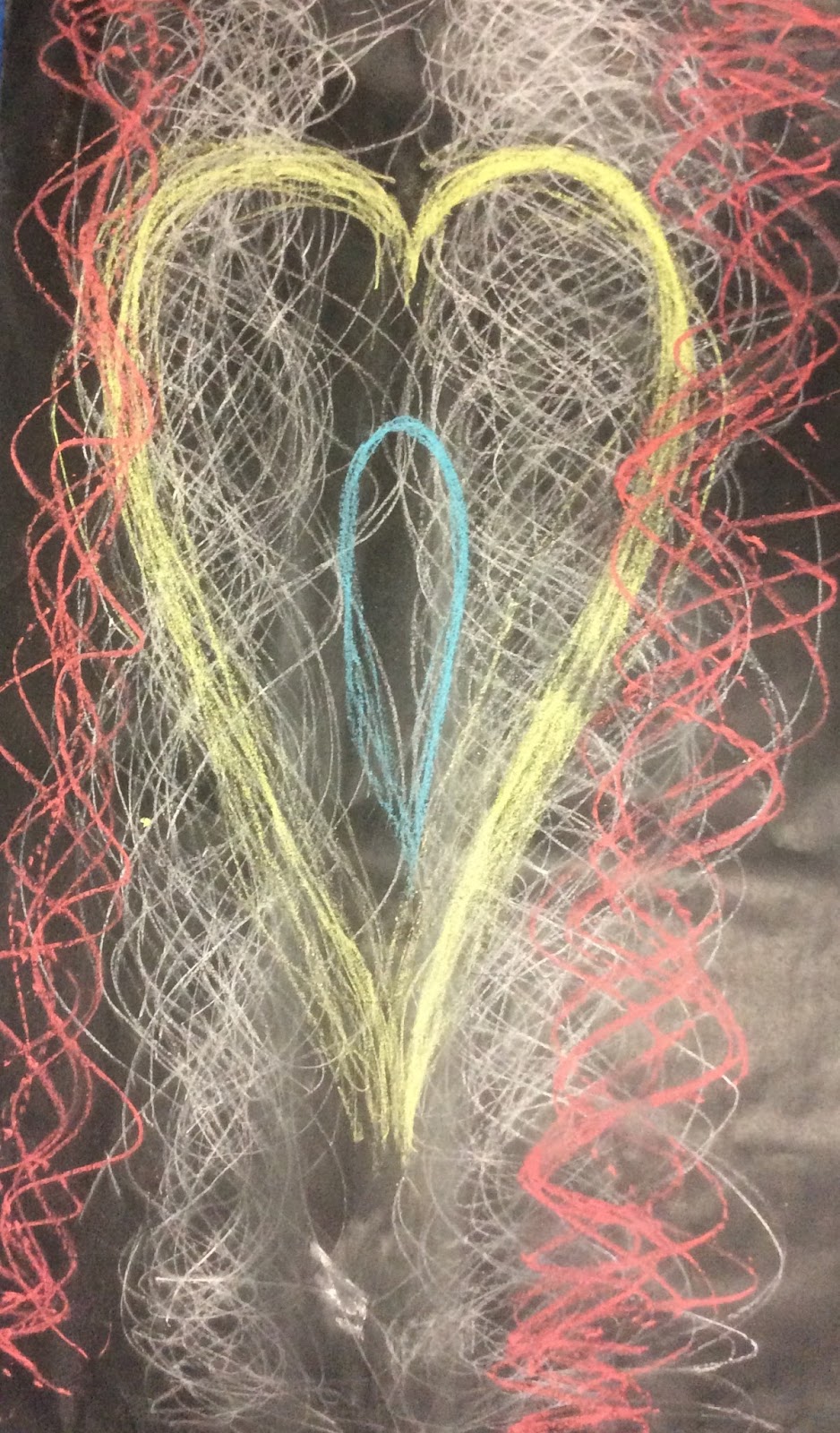
Although I did this lesson with my fifth graders, I have confidence that all  of my students across grades K-5 could do it successfully.


It was a great confidence-building activity, too, and it's not a lesson that a single person worried that they had gotten "wrong," even my hesitant artists.


Want to try it in your classroom? Here are few tips: Collect skateboards for a couple weeks beforehand- kids forget them, even with notes in their backpacks. Have tons of smocks on hand. Pre-cut your roll paper to reasonable lengths to save kids' time. Make sure that you have two each of whatever media you want to offer, one for each hand (two red markers, two aqua chalks, two black charcoal sticks, etc.)
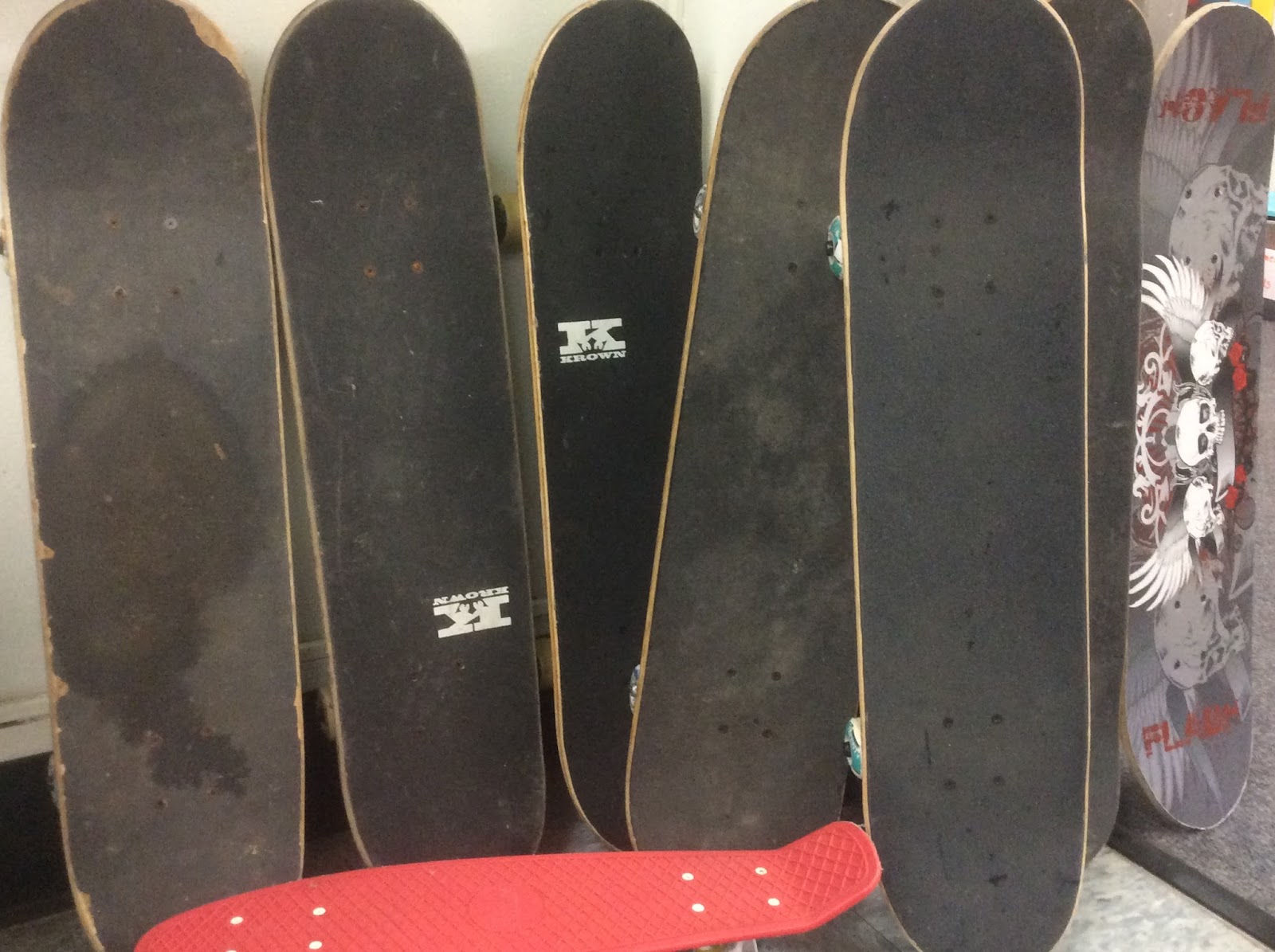
You know art class is about to get awesome when you walk in, only to see...
Want to try it outside in the sunshine? Skip the paper, add traffic cones, and do a temporary art installation on your playground blacktop, driveway, or sidewalk with sturdy bright chalks. It'll stay until it rains.  Video and photograph it, and make a little movie of the experience to share at your art night.


This is a sharing lesson. As in, one that I feel I really, really need to share with all the art teachers I know. And the parents, caretakers, and camp counselors. Try it out! The world, and schools, will be better places the more kids experience joyful, anxiety-free, movement-based learning experiences.

One of my New American students: Mrs. Elliott, what was that guy's name again?
Me: Who, Tony Orrico, the artist we looked at?
Student: Yes, him. I am Tony Orrico, Mrs. Elliott. [hits chest.] That's me. And this is really your job? I would like to be an art teacher someday. I can't believe this is your job. And I am Tony Orrico.


Saturday, April 9, 2016

Fine Arts Night Success!

On April 7, Edmunds Elementary School hosted its annual Fine Arts Night for grades 3 through 5 students. Fine Arts Night is unique in Burlington School District to Edmunds Elementary, and celebrates both the artistic and musical achievements of the whole student body. 

Lots of families and loved ones came to support our artful students!

Over 500 artworks were on display, including abstract paintings, 

5th grade abstract paintings

recycled paper journals, 


still-life pastels, 

Pastel fruit and vegetable still-lifes
origami relief paper sculptures, 

Radial symmetry in origami relief
amazing self-portraits, and sumi-e ink paintings accompanied by haiku poetry. 

3rd grade portraits

Fourth graders loved the opportunity to use a drill, saw, and other woodworking tools to build creative kinetic sculptures in a challenging medium.


Music teacher Betsy Nolan conducted EES music students in amazing performances of both classic folk and modern pop songs.  Students provided all of the instrumental accompaniment to the singing on xylophones, ukuleles, recorders, and various additional percussive instruments. You can also visit her music page if you missed the show, and you can watch the whole thing!

Grade 4 music students
Performance and show of work are curriculum standards across both music and visual art, and students did an outstanding job meeting those learning goals. Listen to the grade three students play Sweet Chariot! Betsy is a marvel!


The evening ended with nearly 150 grade 3 though 5 students performing a joyful rendition of Uptown Funk to raucous applause!

Bringing the Funk.
For real. The students are not doing karaoke here, they play all the instrumentals. Watch this!


Thank you to our supportive families and friends, and to all the amazing, artful students!

Tuesday, April 5, 2016

EES Arts Night This Thursday, April 7, at 5:45pm.

You are invited to attend Arts Night this coming Thursday, April 7, here at EES!  
The art show begins at 5:45pm., please enter through the Main Street doors.  
Begin heading over to the concert at 6:15pm., the show begins promptly at 6:30pm. 

Gr. 3 Self-portraits

All students and families are encouraged to attend this important culmination of the work they have created this year. Please call the Main Office at 864-8473 if we can help provide transportation for your child to this event.

Gr. 5 Radial Origami
Your young artists and musicians have been creating amazing work this year,
 which they cannot wait to share with you!

Gr. 5 Abstract Paintings
Hope to see you there!

Gr. 4 Chalk Pastels

Wednesday, March 30, 2016

Wind Tube Challenge!

Having gone full geek, I decided recently that my life was lacking without my own wind tube. After using them in other places, including at Champlain Mini Maker Faire and at Wildflower Studio in South Burlington (never heard of it?! Stop reading here, and go visit that place. Amazing, amazing, amazing. Bring your kids. Or leave them at home and go have all the fun yourself.)


Thanks to the marvel that is Exploratorium's web presence, it wasn't too hard to figure out how to make one for myself with these directions.  With the convenience of online shopping and generously shared acetate from Samantha Spisiak at Wildflower Studio, I had my supplies together within a couple of days.

Why does an art teacher need a wind tube?  Because artists are the original scientists. We like to tinker, experiment with materials, build interesting shapes and designs, and see what happens. We also like our stuff to look great, too. And if my class can be the entry point for either budding artists to learn and love science, or for science-minded kids to love art, well then I have won at the whole interdisciplinary teaching game.


Let me just tell you, when kids came in and saw a balloon levitating in my class room, mysteriously and wondrously hovering in a funnel of wind, they wanted more. No child, not one soul, asked what the art teacher was doing with a wind tunnel.


By contrast, when I brought it to my son's school for the Maker Faire this week, an adult asked me what I teach. I said art. It worries adults when we don't fit in boxes. He looked puzzled, disappointed, and then irritated as he demanded to know, Well, why not science?


Because I love all the subjects, I said. Because if I teach art, I can teach everything. I can blend art and science and writing and math and movement and more.  It's all there in the art room.

Now, you might argue it's all there in science, too, and I sure hope you are right. We are a weird system of silos in public American education, so I hope more and more teachers are broadening their approach.  In art, 5th graders had twenty minutes to lift a little plastic sea creature out of the tunnel using a selection of materials. The challenge, which the kids didn't know, was that no single item would work alone.


The students had coffee filters, strawberry baskets, paper bags, cardboard tubes, string, pipe cleaners, tape, and small plastic bags. They also had markers and crayons, because, you know, aesthetics.

The coffee filter, which looks like a parachute, seemed the obvious choice for most students, who worked in pairs. But a single coffee filter did not catch enough air to provide the needed lift.


That when you go back, redesign, and try again.  Just as we were running out of time, along comes this guy:


Quietly, thoughtfully, confidently, he connected five coffee filters at varying heights to a single plastic octopus. It flew right out of the tube, all the way to the ceiling. The other students were floored. One great thing about varying what and how I teach is that it lets different students shine in ways that excite and surprise the class.  He got applause.

This is engineering. What does this have to do with art? Good art needs a good engineer. You don't want your sculptures to topple over, and you want that windsock to fly. Engineering is a basic skill that can build into many life directions. Science is one. Art is one, too.


Unlike the sea creatures, my son was a bit heavy to lift out of it, no matter how many little parachutes we attached to him.  Every design has it's limitations.


 Oops. Forgot the fan. Maybe more wind next time.


Friday, March 18, 2016

Shapes Are Poppin'! EES

  In Second grade, the artists are poppin'! Lately we have been talking about some big, fancy sounding art words like "contrast" and "contemporary." We looked at the incredible, contemporary (current) artwork of the pop artist Burton Morris.
Penny A Pop, Burton Morris, Serigraph Print
Students learned how pop artists take easily recognizable, everyday objects, such as cans of soup, packages of candy, or common office supplies, and make those common objects the subject of an artwork. 
Coffee Cup 1998, Burton Morris, serigraph print
This practice "elevates" those objects into something extraordinary, like this cup of coffee. The bold, graphic shapes, strong contrast in colors, and sense of movement in the composition make this no ordinary cuppa joe. 

I had seen this lesson online which inspired what I did with students, which belongs to an art teacher who used Burton Morris' work as a jumping off point for a Valentine's Day project. The results are lovely, and it is an excellent lesson in process for sure, which I used in very much the same way with my students. I avoid "holiday-themed" lessons, but it seemed like a great start to a potential geometry connection.

Ta da!  These second graders have some talent.
Second grade artists chose a common two-dimensional math shape, and by adding effects such as outlines, movement lines, and shine, made the ordinary extraordinary!

Did you know that hexagons could look so cool?
Classes brainstormed lists of math shapes on the board, and selected one that they felt was both commonplace and held great potential to be awesome.

Trapezoids!
It is making for one seriously eye-catching display to see all of these shapes zooming, falling, and bouncing around the page.

Rhombuses blasting off
Students felt that some of these projects are viewable from different angles, and were rotating their pages to find that a shape that looked like it was rising now looked like it was falling, a discovery about which artists were pretty excited.

Rectangles!
Trying this lesson in your own classroom? Awesome. This project also works in tons and tons of scissor practice, and can be easily modified for students who would benefit from tracing shapes or using adaptive scissors. Tracers or stencils can also be used in reverse to help students outline the shapes with marker.


The basics are the same as in the lesson I linked: begin with the colored background, altering the edge and cutting out V's. Mount on black paper and alter the straight lines to echo the edge of the colored paper, leaving a border. Cut out one large shape (some kids may want rulers), and 2-5 small ones. Outline shapes in marker, and add the white paper "shiny spots" and movement lines. It took most kids three 45-minute class periods. One more tip: I used colored copy paper instead of construction paper. The colors are clean and bold, and it cuts with a nice clean edge.


Come see the display in the 2nd floor hallway to see how our artists have created their own pop art!

Boing!


Friday, March 4, 2016

Student conversations are the best! EES

Two third graders were sitting with me in art today, having the following conversation:

Student A: Did you know that you have this thing in your brain called an umbilical cord?

Student B [rolling eyes, like it was obvious]: Yes, I know.

Me: Huh?  Um, that's the thing that connects mamas and babies before they are born. It was where your belly button is now.

Student A [irritated]: No.  Not that umbilical cord Mrs. Elliott. The other one. The one in your brain.  You know, it's the one that connects your brain to your imagination.


Oh. My. Goodness. Sometimes I think my heart will burst with my love for children.
 Thanks for sharing them with me!


Monday, February 29, 2016

Vacation Makin'

Oh, vacation, it's so hard to see you end. Now that my boys are bigger and pretty good at entertaining themselves with mud, books, and elaborate Construx projects, I have time in life again to make stuff. The first order of business on vacation was to make myself my family a giant carrot cake which  I could eat for breakfast we could share for dessert.

Note: children like to help frost messily, but the flavor is unaffected.
Having kids help you with the cake is great, because they lick their fingers so much that you immediately have to keep the cake within the family. Don't want to share a slice and share those germs, since it is a potential source of that cold we all just got over. More for me.

Just add a cup of tea.
Some of what I made this vaca was for the kids.  This felt board is similar to one I had in the 80's, and took less than an hour to make.

  I took two full sheets of felt and glued them to a cardboard backing. I used one blue and one green, but you could use any colors.


Then the kids and I just cut out shapes to work with. A big variety of shapes is key to increase creative potential, but my boys also had a couple of non-negotiables, like fuzzy little horses.


  It's great fine motor practice to cut fabric of any kind, since it is a little more challenging than paper. The material is fuzzy enough to hold itself in place and make pictures.  This activity travels well, especially in the car.

The kids and I also checked out a fun new lesson idea from Cassie Stephens. We love printmaking and do it often at home, so my toddler and I did a modified version one chilly afternoon. The hat and mittens are printed. Painted paper is used for the scarf.  This might also be the first time that my littler guy has made recognizable facial features, which is pretty exciting.


Other projects were for me. Making lotion, pouring candles, patching a quilt, covering old pillows in a new color,

The kids thought the dino was a perfect match.
Crafting a new wreath,


And painting a sign over the door to our chicken coop.


Totally useless, totally cute. Idle hands make me crazy, and the piece of wood was just sitting there.


There has even been time to begin a sketch for a new painting. My own artwork is graphite and watercolor, and generally take me just short of forever. So this vacation offered enough time to visually think through and plan in idea, and this is where my sketch is so far.


My son asked me this morning: "Mom. When will you be done with that?"
Me: "Like, the whole thing?"
My son [rolling his eyes]: "No. Like, when can we go skating today?"

Oh. Right. It's his vacation, too. Off we go enjoy the last day of it!