Wednesday, April 19, 2017

Pinch Pot Creatures

   Children love clay. 
SO much.


For many years, EES students have spent a week per year heading to BCA's clay studio, but, alas, BCA is in the middle of a move to a new home on Pine Street, and we will not go this year. This is approximately what the children looked like when I told them this news.

Pixar shows it well.
In flew the PTO to rescue our students, by purchasing a couple hundred pounds of air-dry clay!  Thank you families, you saved the day! While I don't have a kiln, we were able to build lots of non-utilitarian sculptures and vessels, which while they are not safe for food, look totally awesome.


BCA has primarily had students throw clay on the wheel, so for many of these young artists, hand-building with clay is all new. The techniques I wanted 3rd and 4th graders to have include slipping and scoring to attach parts, and the know-how to make a basic vessel like a pinch pot.


The class looked at many examples of how artists use pinch pots as a basic form for a bigger sculpture, and were inspired to make a variety of aliens, creatures, animals, and monsters.
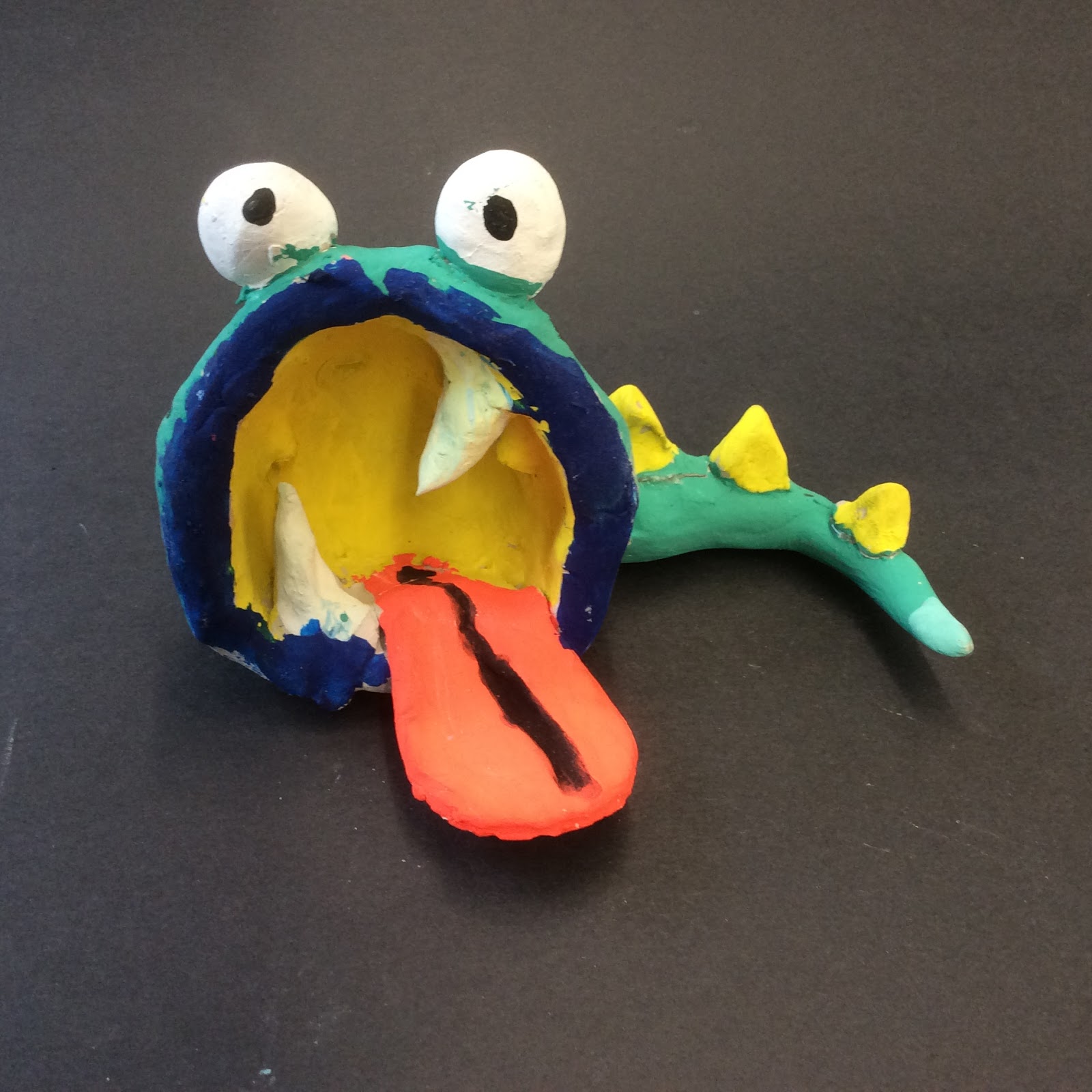

The artist of the work above wanted hers to be useful, so she poked several holes in the back to put lollipop sticks into, to display candy.

The back, with five holes for lollipops.
Students discovered that like with all clay, fired or air-dry, pieces which are not well attached are prone to falling off. Fortunately, students could hot-glue on anything which detached.


Lots of artists' work evolved into multi-media sculptures, adding details like feathers, pompoms, or wire.
Vampire bunny
Long wire eyelashes
Some artists made "minis" to either attach to their main pinch pot, or even to sit inside of it.

Mama and baby frog with wire "fly"
Stacked pinch pot alien
The "Baby" creature sits inside of, and can be removed from, the larger one.
One artist even decided to make hers conjoined, creating distinct faces and designs for each part.


We used SchoolSmart grey clay, and while its working properties are very similar to that of real clay, it was more crumbly when dry than expected and far more fragile than the real deal. If you have had success with a different brand, please share about it!

For students, it was just so exciting to finally have their hands into clay again, that they didn't mind the texture one bit. They look forward to using it again!


Saturday, April 15, 2017

Clay Dessert Containers

If you haven't eaten in a while, go get a little snack and come back to this later. You will not want to read this post while hungry.

I warned you.
Most humans love food. So it is pretty easy to get a group of children worked into a frenzy over the idea that they will be creating homages to deliciousness.


The real agenda of the project was getting students to consider how to create hollow-form vessels of three dimensional objects. Students used a planning sheet to draw both what their work would look like from the outside, and also what shapes would be needed to create the object out of clay, as a container.
A Chesster ice cream cookie sandwich
Consider this cookie sandwich, above. To create this object as a hollow-form container, the student drew a plan that showed he would need two circles of the same diameter, and a long, rectangular strip of a length slightly shorter than the circle circumference. Clay plan in hand, he created this accurate work out of clay slabs which he rolled and stretched on his own.


The plans were created by each artist prior to beginning in clay. The student who made the cake above drew a plan to include two same-size triangles, two rectangles that shared their long side with the triangles, and a square for the back panel.


The goal of this approach was to overcome the guess-and-check approach that can lead to frustration and endless restarting. Using relative measurement (the length of the rectangle needed for this cupcake wrapper is the same as the circumference of the circle for the bottom) lets students make a plan without to much pressure- no rulers needed.

Hot cocoa, whipped cream, and mini-marshmallows!
Math and geometry-minded students excelled at this approach, and plenty of creative space was left for students to create an idea truly their own. I have often seem this project done with a lens I think is too narrow (everyone is expected to make a cake, or everyone makes a pancake stack) to allow for the kind of individual expression and differentiation I look for in a lesson.


The simplicity of the approach- create a three-dimensional, hollow container using your knowledge about geometric forms and faces- lets students explore a wide range of responses at their own level.


Our inspiration artist was Wayne Thiebaud, who is a painter. He is an American contemporary artist, currently 96 years old, and is well-known for his artwork depicting enticing, colorful objects, particularly food.
Cannoli
The approach also let students run into creative problems, and to have to search for solutions. The artist who made the cannoli above rebuilt this project twice, after finding problems engineering the half-column forms proved more challenging than he expected. But I emphasize as an art teacher that children finding creative solutions to the problems they encounter is, by far, more important than whether the end-product is what the artist initially envisioned.


 It's pretty certain that by now you want dessert, even if you did take the snack advice at the beginning. Life is short, go have a treat!


Tuesday, April 11, 2017

Digitally Colored Grade 2 Self-Portraits!

This is a self-portrait lesson started out traditionally, then took a high-tech twist using iPads and a new-to-me app that I love!


Like many self-portrait lessons, students began by learning about the proportions of the face, and drew themselves in pencil. 


Teaching facial proportion, and having a good foundational understanding of it, allows artists to take creative risks through altering those proportions- think of comics and caricatures- exaggerating a specific feature or area to communicate an idea to the viewer.


But teaching proportion in self-portraiture does not have to be repetitive or boring! This lesson is getting students very excited, and several students are reporting working on self-portraits at home right now. 

When they were finished with their pencil drawing, students outlined in black markers and erased the pencil. Why is this lesson exciting to students? Because of the next part- we colored them digitally on iPads, using an app I found recently, called Colorscape! (Other art teachers: if you have used it with your students, tell me about what you did with it! )


Artists used iPads to take a photo of their artwork and upload it into Colorscape, which turns each drawing into a digital coloring page. 


Students experimented with virtual paintbrushes, pens, watercolors, and paint bucket tools in the app to color their work digitally.


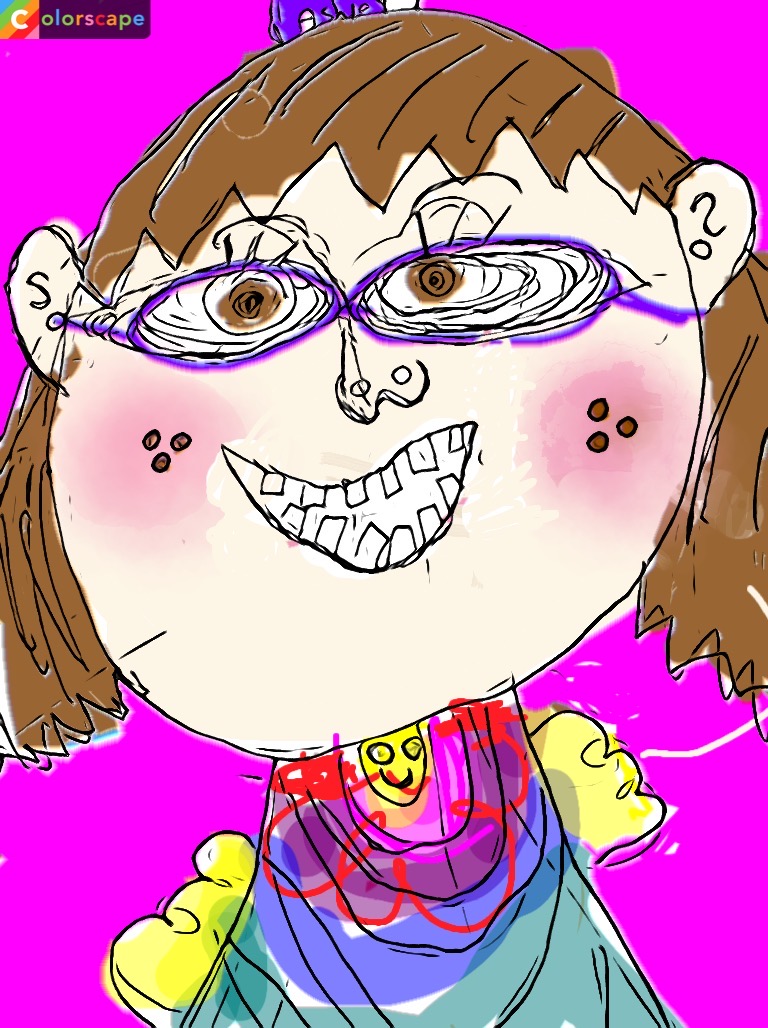
 The original drawings are shown side-by-side here with the finished Colorscape work.


This self-portrait lesson could not have been any cooler!  It was also worked incredibly well for different developmental levels. The iPad technology worked universally for the student population, allowing students to really use virtual materials and tools at their own level.


Students who were ahead could continue to experiment with tools and techniques, and produce multiple finished images, such as these:
                                        

This app also works very well for non-digital end-products as well. Several students in other lessons (like landscapes, for example) are using the app in art to take a snapshot of their work and color it digitally to help them make decisions about which media to try on paper- such as whether to use marker or watercolor on their landscape, and what colors to try in each area. I look forward to students doing lots more with this technique!


Tuesday, April 4, 2017

Rock Out! EES+The Fleming Museum of Art

I've been working on something big, and I am so excited to tell you about it now.

EES+The Fleming Museum present:

Rock Out!
A Community Art Scavenger Hunt


Here in Burlington, we are super lucky to be surrounded by some great museums. ECHO, the Fleming, Shelburne Museum, and more are frequently full of children. Just not all the children. Because for every student who tells me about a weekend museum trip or family membership, I know several others who have never been there, regardless of how close we might perceive these places to be.  Sometimes, admission fees are an obstacle, other times, families lack transportation, awareness of the institution itself, or think that they will not be interested.

It's my job to change that.


Rock Out! is a community scavenger hunt I conceived of and presented to the Fleming Museum of Art, and they were game for my craziness.  The idea went like this: each child paints a rock here at school. Rocks are hidden with free passes to the museum, all over Burlington- outdoors only, in public parks, outside schools, and on sidewalk greenways.  The finders can take their whole family to the Fleming for free between April 7 to May 21, and  they can keep the rock to begin their own art collections.


The Fleming Museum of Art is an awesome institution right here on UVM's campus. Full of paintings, photographs, sculptures, weapons, mummies, and ancient artifacts, it is both walking distance from downtown and also right on the city busline. There is really something to captivate everyone, but many Burlington children have simply never been there. This project is intended to encourage families to try something new together! This project is thinking beyond my own student population at Edmunds to include families, residents, and visitors across the city. The aim is to have fun and rewarding experiences viewing art at the Fleming, which could ignite a passion for art and art viewing in the future.

Want to participate? Talk a walk and keep your eyes peeled. Over 300 rocks (attentively and creatively painted by my students!) and attached notes will be waiting for you. Look along the waterfront, in the city parks, on wall and window ledges, and any other public, outdoor spaces in the city! It will look something like this, just sitting there, waiting for you.

"Hello! I'm so glad you found me."


Friday, March 31, 2017

Math Language in Grade 1 Collage

First graders are finishing their amazing self-portraits!


Students are learning about how to use math skills in their art-making to increase accuracy. They began with examining the proportions of the face and learning about how to use math vocabulary to talk about where facial features are located, e.g. My eyes are in the middle of my head. Half of my face is below my eyes, and half is above. My head is an oval.


Artists felt their faces and used comparative skills to find out that the bottom of their nose is, on average three quarters of the day down their head, and that the space between their eyes is also about one eye-width wide, making their whole face about five eye-widths wide.

Artists also discussed relative measurement, and used the size and shape of their heads to create a pattern-piece for tracing and cutting out hair which fit the head naturally. Because we were making these portraits with paper collage, students could draw and cut the needed shapes easily, and compare them to the next shape needed.


Students talked about creating expressions with their facial features that tell the viewer how they are feeling.

As a group we also discussed how we are so much more interesting than just what we look like, and so students added lots of details and background items that tell the viewer more about what they love, what interests them, and who they are inside.


Tuesday, March 14, 2017

Insect Prints

Art and science merge naturally in an art room, as you have seen my students do here, here, and in many other lessons as well. In this lesson, fourth and fifth grade students observed, drew, and printed insects.


When a teacher tell a class that they are doing a lesson on insects, the reaction is predictably split between abject horror and total exuberance. Knowing that some students will be thrilled to look at samples of insects (I am now the proud owner of glass-encased creatures in the classroom including a Blue Morpho butterfly, a scorpion, and a tarantula), while others may find looking at specimens is uncomfortable to do, so I make it optional.

The library has plenty of options for students who need a little distance from their insects, and many students chose to work with photographs or field guides to make their prints.


Now, technically, insects have have six legs, so our helpful friends the arachnids are not included. The array that fits under the "insect" category is pretty dizzying and beautiful, and beetles especially captured a lot of student attention. Stag beetles, scarab beetles, and dung beetles are shiny and metallic-looking, like little jewels, and were popular among these young artists.


Learning to really look is a skill scientists use all of the time to make correct observations, whether in a lab or the natural world. Differentiating between similar creatures is exactly what we expect artists in field guides to do, to help us identify what we are looking at. The tiniest details matter, especially when multiple species share significant similarities. Where a leg is jointed, how the wings are shaped, and where limbs attach to the body all provide useful identifying information. Scientific drawing is a skill that can be taught very early, like in this fun game I began a couple years back.


Students made a series of five prints (one on flat colored paper, and four on folded cards), and tried out different printing inks and effects, such as offsetting multiple colors or creating gradients.


The process involved transferring a drawing to styrofoam printing plates, and compressing either the insect itself or the background, then using brayers to ink the plates.


A piece of paper is pressed and rubbed onto the print plate (how I dream of students having a small printing press!), and the print is pulled.  Many of the compositions were dynamic, and some were outright funny, like this one saying, Goodbye!

Wednesday, March 1, 2017

Learning Perspective (Not The Art Kind) From My Students.

If you have ever been on Pinterest, it is abuzz with beautiful ideas for young children to explore colors, textures, and play. Knowing several other teachers who regularly and successfully use the ideas they find, I decided to try out a sensory bin idea for Kindergarten carpet choice time in art class.


As the blue rice and sea creatures came together into these beautiful bins of oceanic exploration, with their endless pretend play potential, I have to say that I was feeling pretty pleased. The kids will be thrilled! They will love their new station, and will clamor to use it!  


So, as the ocean-blue rice was drying near the doorway, waiting for my kinders to play with it, my fifth graders arrived for their first-period class.


The very first fifth grade student in the door paused next to the rice, looked at it a moment, and calming stated, shaking his head, "Wow. What a waste of food." He walked to my carpet and sat down, maturely ready to start class with me, a teacher who just. didn't. get. it.


Here's the scoop: He was right. I was all at once grateful for his perspective (and thanked him) and embarrassed at my own pride and ignorance about the project.
That bag of rice could feed a family for most of a week. Food security is an ongoing issue for many students, and yet this sensory bin suggests that food is abundant and not of any great value, which of course any thinking person would know is untrue. Yet, I had failed to think about it.

Many blogs treat rice as though it doesn't matter, shrugging at using the food staple for play, stating things such as "it's very inexpensive," or "I spent less on rice than on a box of markers, and it lasts longer." But those things are beside the point- the point is that in using food for play, I failed to consider other perspectives, which are real for the people who experience them, and need to be respected.

I am still learning. Learning everyday from my amazing, insightful students.